Age-smart learning worlds
Six paths span ages 6–9, 10–12, 13–17, 18–29, 30–49, and 50–65+, changing the decisions, language, and financial context rather than only reskinning one lesson.
Practice money decisions before the stakes are real.
A low-stakes educational simulation that makes financial tradeoffs visible through choices and consequences.
Learners who understand more by making decisions than by reading another definition.
Not publicly available
Product creator, operator, and development lead
01 / The operating problem
MoneyQuest uses guided, low-stakes simulation so learners can practice decisions without putting real money at risk.
02 / The product system
Six age-smart worlds for ages 6 through 65+
Eighteen games and thirty-six consequence-driven rounds
$1,000 paper portfolio with sourced company research
Leagues that reward judgment, not trading frequency
03 / Inside the product
This is the documented product direction and available build evidence—not a generic category promise.
Six paths span ages 6–9, 10–12, 13–17, 18–29, 30–49, and 50–65+, changing the decisions, language, and financial context rather than only reskinning one lesson.
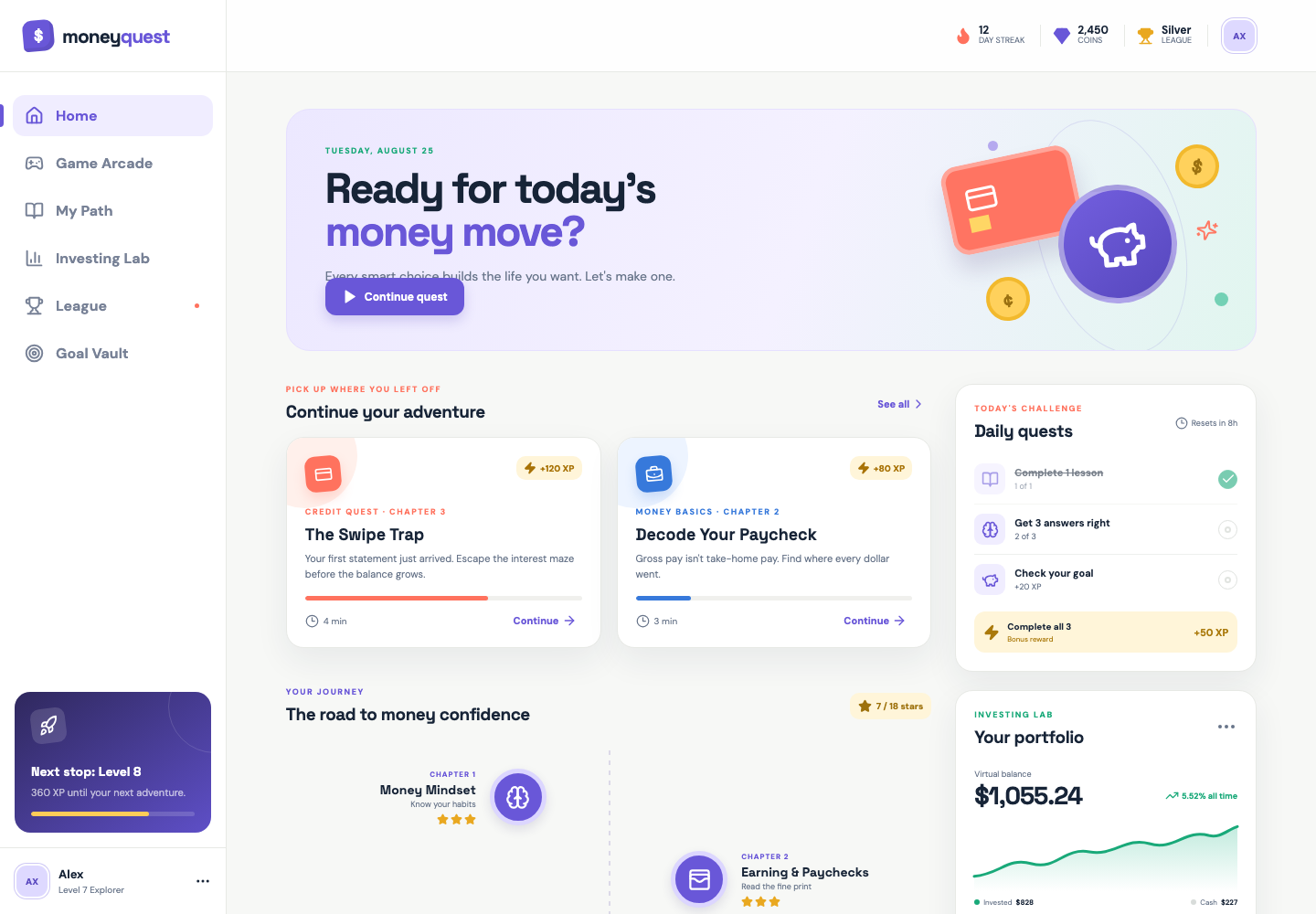
Eighteen games with thirty-six rounds reveal consequences and displaced tradeoffs. A six-chapter teen path includes the interactive Swipe Trap credit-card mission.
Learners receive a simulated $1,000, can practice fractional-share decisions, and must record an investment thesis and risk before a paper purchase.
Company fundamentals come from the SEC Company Facts API, while curriculum links to FDIC, CFPB, FTC, Federal Student Aid, IRS, Investor.gov, NAIC, and NIA sources.
Private or age-banded competitions can run for one, two, three, or six months, with scores combining learning, research, risk habits, and performance—not trade frequency.
The youth MVP excludes direct messaging, behavioral advertising, margin, options, shorts, penny stocks, and crypto; server persistence remains gated on age-aware identity and guardian consent.
04 / Guided workflow
The screen above is an illustrative concept interface. This walkthrough explains the intended workflow and its decision boundary without claiming a working release.
MoneyQuest · Product workflow · Chapter 1
Learn inside a decisionA short story gives the learner a goal, constraints, and limited resources.
06 / The boundary
MoneyQuest uses paper simulation only. It is not investing, financial advice, or a brokerage service.
Educational simulation only. Not financial advice.